Clean water cleanses the Self – a review of Slow River by Nicola Griffith
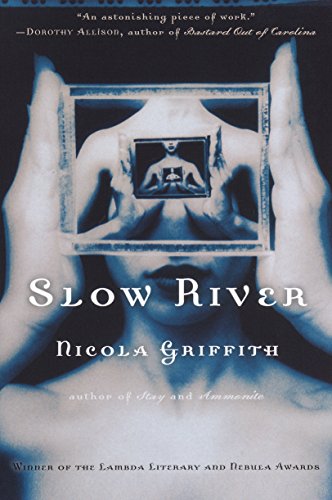
2019 Books & FictionIn Slow River we follow the destiny of Frances Lorien “Lore” van de Oest, youngest child of the world-famous van de Oest dynasty and heiress to the family’s corporate empire. Based in their native Netherlands, van de Oest Entreprises cash in billions in the field of water treatment all over the world, thanks to their patented bacterias eating the pollutants in used water. Like any other member of the family, Lore was groomed from early childhood to take responsibilities in the corporation, learning everything about water treatment, from the chemical process to the politics implied.
But the novel opens with the kidnapping of an almost-18 Lore. She escapes after waiting months for her family to pay ransom, barely alive, naked and helpless in an unspecified British town.
She is rescued by a female passer-by, Spanner, who takes her home, patches her wounds and helps her find a new life. She learns to make a living performing various criminal hustles, stealing “slates” (more or less smartphones and tablets), hacking the network, and distributing pornography. But most of all Spanner helps Lore keep her anonymity, with a stolen identity chip and a doctored online background. Because Lore doesn’t want to go home, for something is rotten in the van de Oest family. They never paid the ransom, for starters. And there could be other, darker skeletons in their closet.
The novel intertwines three time-lines: Lore upbringing in the gilded cage of Ratnapida, van de Oest’s version of Xanadu located in a remote New Zealand island, Lore’s time with Spanner, and the present in which Lore, having left Spanner, tries to become legit and do what she knows best. Work in a water treatment plant.
Lore has always felt trapped and used, like she was exchanging one bondage for another. In Ratnapida, she was the toy of her parents’ ambitions, disputes, and worse. During the kidnapping, she was filmed naked, drugged and crying, exposed all over the news. And again with Spanner, who turns out to be a very problematic business partner/mentor/lover, unstable and manipulative, dragging Lore as low as a punk can get.
Can her new life, as a blue collar wage-slave, literally raking shit in water tanks, brings Lore the liberty she is aspiring to? Well, that depends on how well the administration manages the plant. And given what Lore knows about the process, things are not looking good. Trying to keep a low profile while saving thousands from toxic spillage will prove to be an impossible challenge and Lore will have to face her many demons.
Analysis
In this book, Griffith’s talent as a storyteller is evident from her mastery of the non-linear form, giving the reader just enough to figure what’s going on, yet not enough to be exactly sure. Like the best mystery novels, Slow River is a beautifully crafted puzzle that reveals itself with disseminated sparkles. While the narration can sometimes be heavy with the technicalities of water treatment, “the plot thickens”, as the saying goes, when the reader starts to put the pieces together in the second half of the novel.
With strong-willed female characters occupying center stage (for better or worse), and male characters either clueless or relegated to supportive roles( albeit important for Lore to find out who she really is), Slow River may very well be what early feminist critics of cyberpunk were calling for. Don’t expect street samurai running around all guns ablaze: this book is introspective, yet never contemplative. This, however, does not mean in any way that the future depicted here is cute and safe. Lore’s path is brutal, she has to make life-or-death decisions more than once, and most of all she has to assume the uneasy consequences of those choices.
Identity
Published in 1995, Slow River won the prestigious Nebula Award for best novel (no small feat considering Stephenson’s The Diamond Age was among the runner-ups) and, more significantly, the Lambda Award for best science fiction novel with LGBTQ content (joint award with Shadow Man by Melissa Scott). Nicola Griffith is openly lesbian (her wife, Kelley Eskridge, is the author of the novel Solitaire which inspired the movie OtherLife), so, yes, same-sex relationships are represented in the novel. Still, those don’t qualify as a theme: homosexuality is depicted “as is”, with no specific emphasis, no explicit advocacy or heartbreaking coming-out. The main thesis of the book, however, is identity, a topic especially sensible for feminists and the LGBTQ community alike, but nevertheless universal.
Present sequences are narrated from the first person, while past sections are from the third, thus strengthening the idea that Lore is not the same person as she was. Due to a genetic manipulation on her grandmother, Lore’s hair and eyes are naturally gray, like the rest of the family on the father’s side. Her body is a blank canvas, a little too perfect for her to blend-in with the common people she now runs with. Lore has to learn to talk sloppily, to roll her shoulders, and to dye her hair just a little out of sync with her face.
The young woman also has to find out how far is she ready to go to avoid her past. Living with Spanner means to be always on the run to get more money, more food, more alcohol, drugs and sex, and employing all means necessary to keep this circle going. Spanner has given up on hope, Lore hasn’t. Only by reflecting on the differences between she and Spanner, her family and her co-workers, can Lore find out what makes her who she is.
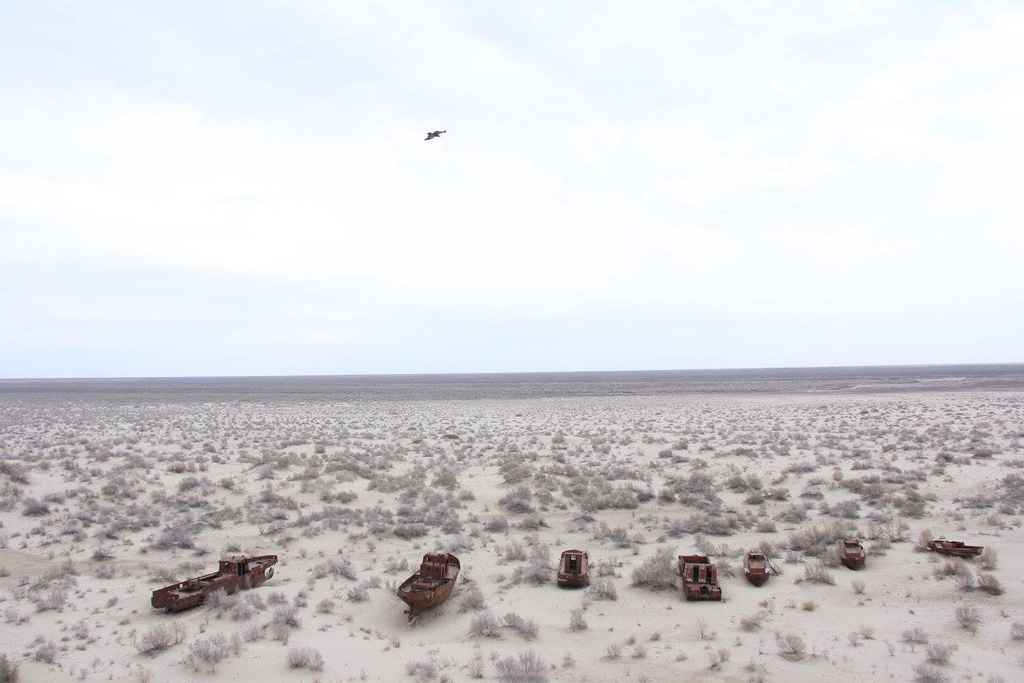
Before being abducted, Lore, then 17, managed the reirrigation of the Aral Sea for van de Oest Entreprises, on behalf of the Kirghizian government. In cyberpunk, no matter the social class, teenagers are seldom allowed to act their age.
Ecopunk
The river from the title is an obvious metaphor for life, always going on, always changing. Filtering the water, from urban waste to drinking water, is also a representation of the cleansing Lore must perform on herself in order to shake nasty habits and fear out of her conscience. The analogy goes further still: the van de Oest process integrates a whole ecosystem. Enzymes, bacteria, algae, fishes, chemicals, and humans are all links in the chain, and things can go south if the balance is broken. Griffith’s narrative explores the systematic relations within ecology, society and family, and the similarities between those, how easily broken they can become, and how hard work is needed to keep them afloat.
Evil megacorp?
The passages depicting the life of the van de Oest family offer a side of cyberpunk rarely portrayed, that of the “evil megacorp” from the insider’s point of view. Despite being almost “Tessier-Ashpool dysfunctional”, the van de Oests are dedicated and believe in the greater good. Family reunions are all about enzymes and filtering, patent disputes and parts-per-million calculations. They are so obsessed with efficiency that the occasional toxic spill is brushed off as collateral damage, and lawsuits are anecdotal news items to watch distractedly. Because in the end, the van de Oest process does indeed provide clean water to millions, and at this scale, is it really wrong to reduce the individual to a statistic? The moral issue, then, is not so much the corporation’s business as the possibility of foul play to insure that it stays a monopoly. But having now lived on the other side of the fence, Lore might have something to say about that.
Slow River by Nicola Griffith is a clever mystery, wonderfully structured, reaching deep into the souls of lively characters and raising important issues about ecology and its economy. Lore is a powerful young woman who knows what’s right, and would not settle for less.
Slow River: 8/10
If you would like to purchase a copy of Slow River by Nicola Griffith, you can find it here.