Inside the Pages of Blade Runner 3: Replicant Night
2018 Books & FictionK.W. Jeter must have been in a bad place when writing his second novelized sequel to the cyberpunk codifier, Blade Runner. I say this because, after a year’s hiatus from reading not only the decanonized series but all literature in general, I dove right back in, head first. To make matters worse, I foolishly chose to listen to it aloud through Google’s text-to-speech app on a long, long trip through meatspace, giving the flavorful text all the warmth and charm of ED-209. Fortunately, in the year’s time that has passed since reading Jeter’s first attempt at continuing Blade Runner, I believe I’ve come unto some amount of understanding and perspective as to why, exactly, it all went wrong, and hopes to whomever wrote the universe’s source code that Replicant Night somehow managed to improve upon The Edge of Human.
Luckily for me, it did. But not by much.
Synopsis
A few years after the events of The Edge of Human, famed ex-Blade Runner Deckard, in desperate need of cash, has signed on as a consultant for a film being shot on Earth-orbiting space station Outer Hollywood. The film is, naturally, a biography based on Rick Deckard’s well-documented final case file, which will ultimately replace the actors’ faces with CGI recreations of the originals’. Meanwhile, Dave Holden, whom most of you will remember as the guy who is instantly wasted at the beginning of the film, shows up on set with a briefcase equipped with an AI version of Roy Batty, because apparently the readers can’t get enough of him. Before he can find Deckard to deliver said briefcase, he’s redirected to the set of the Tyrell Corporation’s Voigt-Kampff interrogation room and is killed by a rogue Kowalski replicant in an incredibly detailed recreation of the first scene. After arriving too late to save Holden, Deckard is given the briefcase and decides to make a return trip to his home on Mars’ colony.
Just watch this. You get the idea.
Elsewhere, there’s trouble in paradise as Sarah Tyrell, templant and murderer of Deckard’s first love Rachel, realizes things aren’t working out between her and Deckard, pondering the benefits and drawbacks of murder-suicide. Before she can carry out her plan, however, she is accosted by two representatives of the “shadow” Tyrell Corporation (the headquarters of which, readers of the previous article may remember, was destroyed by Sarah). Aside from looking and acting as much like the long-dead Eldon Tyrell as possible, these two reps (unironically named Wycliffe and Zwingli) adhere to a cultlike devotion to the godlike powers of the Tyrell Corporation and believe that Sarah is the key to its resurrection. However, before she can claim her throne, Sarah must first enter the ruins of the outbound space vessel Salander 3, which she and her parents had boarded over a decade prior, in order to discover what exactly caused it to return to Earth and crash in the North Atlantic. There she discovers a young version of herself named Rachel, insisting for the remainder of the book that her new companion is merely a hallucination despite all evidence to the contrary, suffering from severe, lifelike flashbacks of her father’s murder of his mother.
Deckard, upon returning home, discovers there is a small packet of water-soluble powder, marked with J.F. Sebastian’s name inside Roy Briefcase, who asserts that he is a vital component in the growing replicant-sympathetic movement (or rep-symps), carrying a list of illegal immigrants to Earth that have been modified to be indistinguishable from human. After purchasing the proper supplies at a back-alley vendor that peddles the chance to meet the god of the buyer’s choosing via similar powders, Deckard partakes of his own dehydrated deity and finds himself in an exact simulation of Los Angeles, particularly Sebastian’s abode. Sebastian, resurrected once more as the god of his own, chemically-programmed realm, discusses the reasons for Deckard’s presence as well as the natures of god and reality before attempting to dissolve his virtual world. Before the drugs wear off, however, he manages to give Deckard a small, ancient first-aid kit, which Deckard somehow carries over with him into base reality.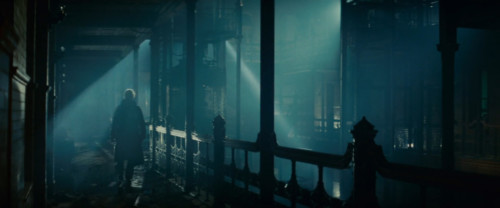
After divulging the events of her mother’s death and father’s suicide upon the Salander 3 (which were erased by her uncle), Sarah murders Zwingli and Wycliffe, returning to Mars and sharing a violent, crazed altercation with Deckard. Deckard, unsure of what to do, leaves his home with Rachel and the briefcase and hustles into a bar to gather his thoughts before being confronted by a member of the rep-symps known as Marley. Marley informs Deckard that the the briefcase, snarkily voiced by Roy Batty, actually carries a meme virus planted by the UN that would destroy the rep-symp movement from the inside out, as the replicants have begun reproducing outside of Earth’s atmosphere. The meme virus would do this by activating a latent instinct carried in human DNA known as “stepfather syndrome”, which works by causing replicant parents to see their offspring as biological threats and increasing their homicidal urges. After a lengthy, repetitive conversation, Deckard, Rachel, and Marley find themselves ambushed by UN black ops led by the director of Blade Runner Deckard’s biopic, sicced on them by Sarah.
Of course, just about everyone in the bar (including the briefcase) besides Deckard and Rachel are killed. Rachel has been whisked away by Sarah to the set of the Bradbury Building on Outer Hollywood, even though the place holds no significance to either of them. Deckard makes chase, following Sarah to the roof of the building, wherein he reveals through a photo inside the reality-transcending first aid kit that Sarah and Rachel were the first natural-born replicants (Rachel was apparently put into stasis inside a replicant transportation casket and was somehow awakened at a later date). Sarah, her unspecified madness reaching a climax, chooses to kill herself. The book ends with Deckard and Rachel making a break for the outer colonies, hopefully never to be seen or heard from again.
Analysis
I’m not saying that Blade Runner: Replicant Night is without merit. In comparison to The Edge of Human, K.W. Jeter manages to further flesh out the Blade Runner universe, dipping into religious imagery (albeit perhaps clumsily handled) through the inclusion of dehydrated deities, J.F. Sebastian’s private world and the cultlike reverence displayed by Tyrell’s followers. In the time between Blade Runner 2 and 3, Earth has been ecologically devastated, while Mars’ emigrant colony is a twisted, crowded series of manmade metal corridors, overrun by drug addicts and black-market salesmen, dripping with pure cyberpunk cynicism. Outer Hollywood provides a look on the future of cinema, accurately predicting CGI facial construction and presenting us with automated, body-tracking cameras. And, most notably, the inclusion of a replicant uprising and replicant children may have helped inspire Blade Runner 2049‘s own script.
Some elements can be traced back to influential works: Sarah’s scenes aboard the Salander 3 seems to be a cross between the cave in The Empire Strikes Back and The Shining set aboard a derelict version of the Nostromo; the meme virus housed within Roy Batty the briefcase is reminiscent of the Rawling virus from Altered Carbon but may have been inspired by Snow Crash; and the inclusion of artificially-intelligent appliances (including a manipulative, nosy calendar), like the life-suspending transportation containers, seem to be lifted directly from Philip K. Dick’s Ubik (the Salander 3’s own onboard computer provides a fresh, maternal take on the smarthouse). The plot’s structure and banter, when kept brief, elicits imagery associated with a hardboiled detective novel.
However, some things just feel out of place. Jeter sprinkles in anachronisms that just don’t seem to fit–while the lantern-lit cabin nestled in the forested mountains of Washington state is more heavily featured in The Edge of Human, Sarah is taken to the ruin of the Salander 3 via a wooden rowboat in the midst of a WWII-era naval graveyard about halfway through Replicant Night. While Blade Runner itself was not devoid of retrofuturistic imagery, there is no marriage or reconciliation of these quirks in its novelized sequels, minor as they may be. Furthermore, like The Edge of Human, Replicant Night banks heavily on the memorable scenes featured in the film upon which it is based–particularly anything featuring Leon Kowalski, who was spared necromancy in some form until Replicant Night’s opening pages. Jeter seemingly refuses to come up with characters that haven’t made an appearance in the original film, but again, none of these recycled characters seem to retain any of their original traits, robbing them of what made them interesting in the first place. While the scenes on Mars and aboard the Salander 3 take place in original locations, the Bradbury Building and its surrounding, darkened L.A. streets are reconstructed with painstaking detail.

The writing itself, however, represents the weakest element Replicant Night has to offer. Aside from lines that are outright laughable (“Numbers don’t mean anything. Except for the number of bullets needed,” and “I have good reason to believe, Miss Tyrell, that you’d like a certain Rick Deckard taken care of. Murdered, as it were,” are standouts), Jeter seems to feel the constant need to remind the reader of previously established material. At its best, the writing is convoluted and drawn-out on a level comparable to his predecessor’s. At its worst, the reader is constantly reminded of each character’s relevance to the plot (I swear, if I have to read that Sarah Tyrell has the same face as Deckard’s long-dead, lost love Rachel one more time…) as well as detailed recountings of events that occurred in both Blade Runner and The Edge of Human. Sometimes, the reader is needlessly reminded of plot points that played out only chapters before. The reasoning for this is unclear–perhaps Jeter is concerned that his audience isn’t paying enough attention, or perhaps he himself found himself unable to pay attention to his own work. After all, the characters’ motivations are completely opaque, outside from Sarah’s irrational, burning desire to embrace the void and take Deckard with her–a desire so deep-yet-poorly-defined that is nonsensical at best. Occasionally, characters are aware of information they were not privy to before, according to the book’s timeline, and certain plot elements make no sense whatsoever. Sarah and Rachel hallucinate their father’s murderous rampage onboard the Salander 3 for a reason that goes unexplained, as does the first aid kit’s materialization in base reality. During Deckard’s lengthy conversation with Marley in the Martian bar, Blade Runner begins to air and he suddenly makes the realization after-the-fact that plastering his name on a high-profile film, whereas a real fugitive would think twice before even thinking about signing any contracts.
However, I have the sneaking suspicion that, coupled with Replicant Night’s long, dreary scenes piled high with roundabout dialogue and plot devices (the rep-symps hardly even make an appearance), this is a flimsy attempt at camouflaging the book’s threadbare, worn plot. Very little actually happens in the book–Deckard gets fired from a cliched attempt at self-awareness, goes on a drug trip, meets with some shady characters in a bar, and watches his wife kill herself after she goes soul-searching and discovers nothing that impacts her murderous urges. And ultimately, Jeter’s work seems to show understanding of neither love nor madness–Deckard retains what we are told is a deep love for Rachel, even though these emotions remain invalidated by any description of memory unseen in Blade Runner, ultimately coming off as a teenager unable to get over his first rejection. Many other characters, aside from copious descriptions of their smiles, are characterized with irrationality seen in the mentally ill, but appear to have no underlying causes, which lends to a sense of generic, undefined insanity.
Conclusion
Unfortunately, I have not had the chance to yet read any of K.W. Jeter’s other works. Dr. Adder has been hailed as a novel well before its time, written in 1972 and containing many of the hallmarks of first-wave cyberpunk, its publication delayed by twelve years due to its graphic content. Unfortunately, Replicant Night reads like a novel written by a severely depressed author, locked into a creatively-bankrupt contract, constantly ruminating on committing suicide without saying something meaningful in the process. While Replicant Night provides us with a few original, clever science fiction concepts, it doesn’t have nearly enough material to stand on its own.
Blade Runner: Replicant Night – 3/10
You can get a copy of Replicant Night here.
Some of the links included in this article are Amazon Affiliate links. If you would like to purchase these items, consider using the links provided and help support Neon Dystopia.
Oh man. Is this book really this bad? I haven’t read it since high school. I seem to remember liking it back then. Almost 2 decades ago. I’m almost afraid to reread it now.
Great write-up.
I love cyberpunk.
I look forward to checking out more from this site and your posts.
It definitely doesn’t hold a candle to the film. But, much like The Crow was for me in high school, it might not hold up after a few years of perspective. I probably would have loved this book back in my angsty teenage days too. Glad you liked the article though!
It wasn’t a good book, but the dehydrated deities concept was so good and the sort of thing that should crop up in sci-fi more often, especially in these post-2049 Blade Runner spin-offs that are still being made, like the Netflix cartoon. Also pretty amazing that this novel came up with the idea about replicants procreating before the sequel movie did. (The resistance idea seems more like a genre trope, which the film also coincidentally didn’t explore.)