Death Machine Session – Glitch Mode Decode Tour Interview
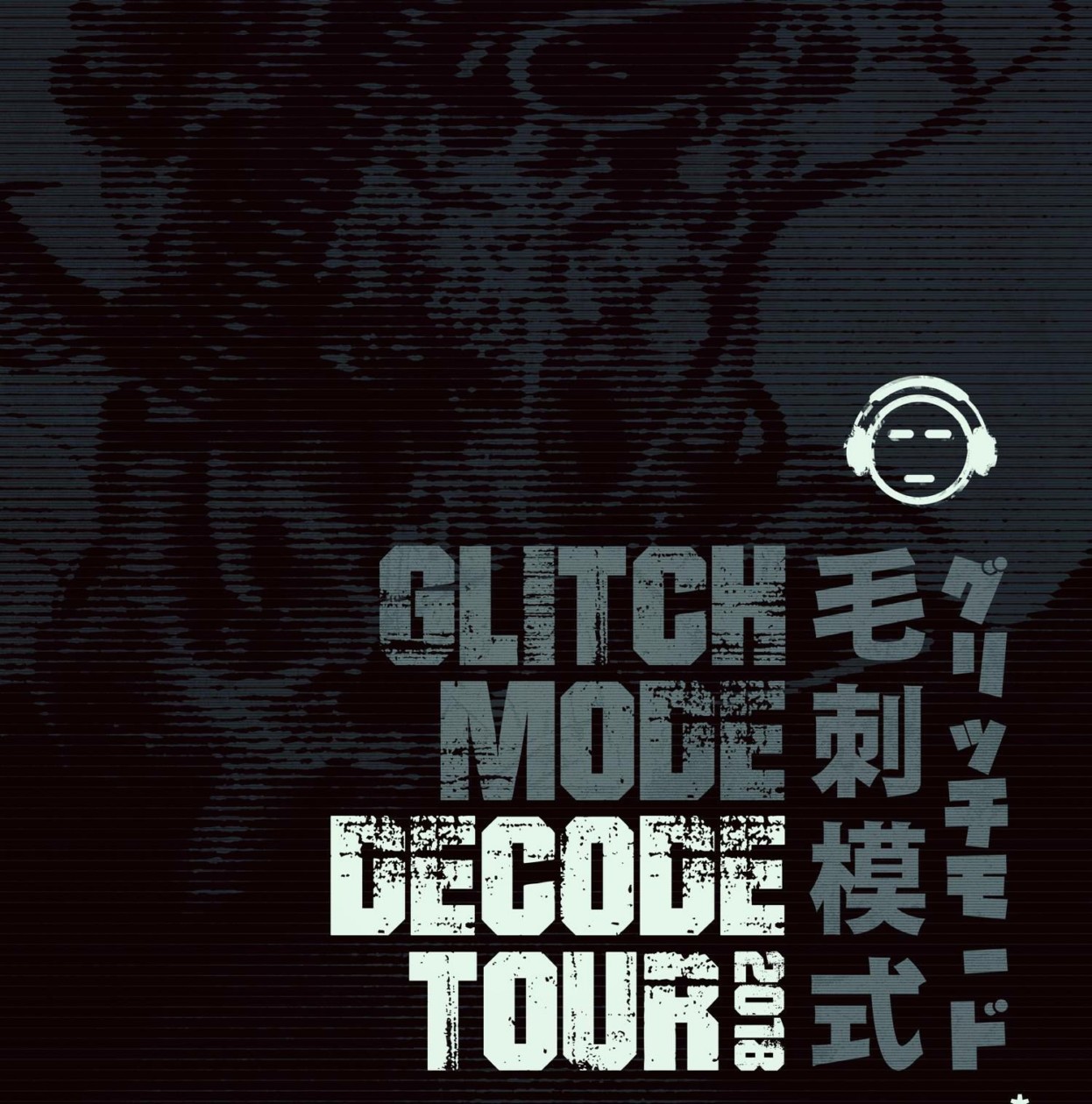
2018 MusicI step into the maw of the RV that has been the home of the Glitch Mode Decode Tour for the last few weeks. It is parked in a glistening late night San Francisco street, and illuminated by the glow of a local curry restaurant. The Elbo Room lays just up the block, having just hosted the night’s show.
Inside the Death Machine, as the RV has been lovingly named, each of us settles in on old style bench seats and surrounding a white table built into the wall of Death Machine’s metal flesh. Energy from the evening’s show bristles in the air in the form of entertaining banter between the likes of Sean and Jenny Payne of Cyantoic, Dan Dickershied and Jordan Davis of Relic, and myself. I set my phone on the table and invite the gathering to join me for conversation.
The interview was a reflection of their performance onstage: compelling, intimate and dissonant. The synergy and chemistry that gives them a powerful onstage presence clear as they practically finish each others sentences, double down on each others jokes and share stories of each others pasts. Glitch mode gave us a peak into the high tech, low life existence of touring electronic musicians.
Neon Dystopia: Let’s get the most basic of questions out of the way first. Where did the name Cyanotic come from?
Sean Payne: I was 18 years old and I had this job that was 9 to 5. It made me never want to have a 9 to 5 again, and I didn’t. It was for medical research, microfiche and microfilm. I had to transfer microfiche to digital. I had no idea what I was doing, but I wandered onto hospital records and they talked about how patients would go cyanotic. It just means to turn blue when you die.
ND: What other music do you find inspires your own work?
Sean: Nine Inch Nails, but not the singy stuff, more like the dissonant, angry stuff.
Jordan Davis: Yeah, Nine Inch Nails is a big influence, but what I grew up with was stuff like The Prodigy and a lot of 90s mainstream electronic artists.
Dan Dickershied: My musical influence differs from a lot of other people on board (the tour bus) because beats and drumming have been one of the only things that I have understood musically to a tee. It was just something that I naturally picked up and it was amazing. So I started out with System of a Down and Drowning Pool. I really started diving into their music and being like, “Okay, this makes me feel good. I enjoy these beats and I want to emulate them.”
Jenny Payne: I share a lot of the influences the others mentioned. Most definitely Nine Inch Nails, several drum and bass artists, old school WaxTrax! Industrial acts, and PIG, that’s a big one. I also have a lot of female influences that have been monumental in my musical thought process: SOW (Anna Wildsmith), Jennifer Charles, Meg Lee Chin, Portishead, Miss Kittin, Nicole Blackman, Lolo…and it goes on. I picked up the WaxTrax! Black Box when I was all of about 17 and fell in love.
I trained musically from age five to my early twenties. This shaped who I am as a human and as a lover and contributor to music. I carry the discipline I learned as a young child with me now and always. I didn’t play much with other children. I didn’t watch TV but for one hour per day, if that. Music was my love, my blood and my sweat during those years and practice was my life. I accomplished so much at a young age, and I have no regrets about the fact that I didn’t make it my life’s work. My background didn’t land me in Cyanotic. It’s my drive and my passion for this music. And my will. Without will I don’t believe success is possible. And yes, Sean is one of the most influential people I know. Speaking of drive, passion, and will, he’s the king.
ND: Cyanotic is clearly cyberpunk inspired. Cyanotic’s new album Tech Noir clearly references the bar in the first Terminator and T2 is a clear reference to Terminator 2: Judgement Day. So besides Terminator, what are your influences from media?
Sean: I Have No Mouth and I Must Scream, great short story. Tetsuo The Iron Man. It’s just a no budget, weirdo thing that sounds like chaos. Did I already say Skinny Puppy? That’s a pretty big one too. I think we just covered Nine Inch Nails, Prodigy, and Slipknot.
Jordan: We’re a bit younger, so we were more video game inspired.
ND: Which video games did you find inspiring?
Jordan: The nerdy ones. I mean all the greats. I grew up playing just about everything.
Dan: Well you designed your own games. While kids were playing games, he was making them. He showed me some of his games that he made. It’s incredible. While all of us were concerned with dating Susie and whacking each other with pool noodles, Jordan was like, “Well I just made this MMORPG.”
Jordan: And hosted it on my mom’s computer.
Sean: That’s why we have nerd love, dude. I was making fan films for the Alien vs Predator movies in 1996. Got to love the Alien 3 reference.
ND: So moving from the fiction into the philosophy, your first album is called Transhuman, and then Transhuman 2.0 is the next one, so clearly transhumanism as a philosophy is really important to you and cyberpunk has a lot of philosophy in it as well, so I’d like to have you talk a little bit about your cyberpunk philosophy.
Jenny: Sean is the epitome of I could literally die in one second, I could be dead in a moment and I am not going to take that for granted. And that’s just Sean.
Sean: My mindset basically is that I am going to die any minute, and I don’t want that last minute to be a bad one with people. I am always trying to be like “Hey! Are you having fun?” I am always trying to direct the scene. Not being an asshole about it, but just like I was a weird kid director. I was like eleven years old going, “Okay, Jake. The Predator is over there,” but it’s just my Dad’s drunk mechanic friend. We rented Alien and Predator costumes, that’s my life. That’s my cyberpunk philosophy. Like I have that Alien 3, William Gibson draft. My dad found it in an LA script shop before you could look for shit on the internet and got it for me. I was like, “Umm Dad for my 12th christmas I would really like the Alien 3, unproduced, William Gibson screenplay from 1987.”
I went to a bunch of film festivals, and I realized that that was the toughest fucking thing to do. I really liked music, and that’s why Nine Inch Nails was really inspirational, initially. It was just one dude. And that’s what was so inspirational about it. When I tried to direct people making movies when I was a kid, I was like, “I can’t. This is a nightmare.”
ND: I would really like to hear Relic’s philosophy, as well. The philosophy in your music is kind of on a different plane, a different cyberpunk perspective.
Jordan: Well our’s is more like a combination of occultism and technology. It’s in a similar vein of high tech, low life. That’s all apparent in the name “Relic.”
Dan: We definitely live that life too.
Jordan: Its indicative in the name that we’re a throw back to something of the yesteryears technologically but still updated.
Dan: My philosophy on what we do is that I see cyberpunk and I like to break that apart. You’ve got the cyber and then the punk. My drumming style is definitely just brash, in your face, and punky.
I just want to sit into a good jam, just rock it out, and more times than not we’ve had people in the audience be like, “Fuck yeah, live drums!” In this genre of music, it’s somewhat of a rarity to have an actual drummer instead of just a beat machine or someone hitting some weird little thing that makes a sound.
Jenny: Its an integral part of live music.
Sean: I have done tours without drummers and I hate them. I hate no drummer tours.
Jordan: There’s just an energy that’s lost.
Sean: Its lost, and that’s the real integration of man and machine for me. A live drummer over cool backing electronics just makes a super processed hyper-synthesized groove. You know that’s a live man feeding on the groove.
Dan: It does and perfection brings us all closer to god.
ND: You guys do have a lot of occult iconography in your stuff. Is there a particular aspect of the occult that you guys find compelling?
Jordan: Definitely chaos magic.
Dan: I enjoy chaos magic, a lot.
Jordan: Thelema. Crowley was pretty on point with a lot of his… well, he was kind of the first western mind to bring a lot of these ideas.
Dan: He brought a lot of it into the mainstream and influenced a lot of stuff, even Scientology.
Jordan: And pop culture. Pop culture owes a lot to him.
Dan: What I enjoy most about it is just calling things into existence. If you think about something, if you manifest something, and you look for it, you’ll see it. And that goes back to pattern recognition.
Jordan: For me, as a programmer, but also as someone who has studied the occult, I see a lot of interesting parallels. I will talk to other programmer friends who have studied certain algorithms, they will find certain mind blowing philosophies out of something weird like how the Roomba operates. You can find a mind blowing thing that’s called an A Star Algorithm. If you study it enough, it parallels some things that you can find studying occultism, like weird inner truths and realities. The marriage of emerging technology, especially with artificial intelligence and neural networking, is bringing us closer to god. That is the next step for occultism for me and my personal ideology.
ND: You guys really remind me of Jim Morrison, or Alan Moore.
Jordan: They are both huge influences
ND: They both build occult story structures into everything that they do.
Dan: It’s just like religion in general, you take these stories and relate them the best that you can to your life. You take from them what you want to project into your own existence.
Jordan: Technology is the new Christianity, the new Islam. Technology is the new great religion.
Dan: Its defining a generation. We already seen that it is defining everything.
Jenny: It’s now required.
Jordan: Everyone is understanding concepts that are so visecerally defined within society. My Grandma has a smart phone, she is 98 years old. We all have these interactions that are understood, and you could build a religion around it technically. There are concepts that have previously been hidden in the occult that are now visible in real life.
Dan: I don’t know if this has anything to do with what we are talking about, but we’re interconnected more now, than we have ever been as a species. But at the same time, we feel so isolated because of that interconnectedness. And that to me is interesting.
ND: The early 90s cyberpunk culture with Timothy Leary was a huge influence in that and he said that the internet was going to the LSD of the masses.
Jordan: And that is actually an accurate statement. Because LSD’s effect is novelty in the brain and that definitely what the internet provides. Constant novelty.
ND: LSD creates this sense of belonging. They’ve been doing a lot of research on LSD recently, and they’ve discovered that there is an area of the brain that is associated with the ego. One of the things that LSD does is it suppresses this area. You experience ego death.
Dan: It’s the same thing with a lot of psychotropics. You meet your maker, or you meet a thing. You don’t feel yourself, you feel part of a mass.
Jordan: I would say that the numbing agent of the internet is social media. The real LSD is the deeper forums and stuff that people go to. The nerdy outlets, that’s where people really connect.
Jenny: So hence the name of your guys last record, Social Drift. Really, everything that you guys were just talking about is all encompassing and makes sense.
Dan: Yeah, Social Drift is about power influencing an entire social entity to do things.
Jordan: Drifting from society.
Dan: The malcontent, being the malcontent.
Sean: The world just became the movie Strange Days. That’s all it is. If you want to talk about LSD for the masses it’s just Youtube.
Dan: or Idiocracy.
Sean: An 80 year old grandma can just watch a cat doing funny things for hours on Youtube.
ND: I was just talking with Relic for a while, so I’d like to shift gears back to Cyanotic.
Sean: This is kind of a weird family. This is some fucked up little union. I’ve known Jordan 11 years. I’ve known him since he was 17. He’s been a cool brother that I didn’t have. He is my fucking weirdo brother. There is this union, there is a lot of cool intersectional understanding and everybody comes from the same kinds of genres and hybrids of those beats that are embedded in those genres.
Jenny: We’re all cut from the same cloth but we all have our own ideas and things and then we bring them all together.
Sean: It makes a cool thing. It’s the whole thing that I’ve tried to do with Glitch Mode. It’s not just an organization, it’s a union of souls. A union of souls with a dedicated purpose.
ND: I wanted to ask you about Glitch Mode Recording as a label. I understand that you created it originally for your own music?
Sean: Well no. It was always kinda intended from the outset to be what it is. The first thing we did as a record label was a compilation. This was 2003, it was our first release. It was concurrent with the demo that we put out, but that’s just because we were like, “Why don’t we put our demo.” It was always about promoting things that were doing something interesting in the electronic underground that I was somehow connected with, but not part of. I’d be like, “you two gotta meet.” Like that time that Jordan and I were on Bit Riot Records, and I still work with Eric who ran that place.
Jenny: And now he releases music on Glitch Mode. It’s this weird incestuous relationship.
Sean: Death and Decay.
Jenny: He makes great music.
ND: So have you had any challenges with Glitch Mode Recordings?
Sean: Always. You kinda live and learn. I always end up sticking with it.
Jenny: There have been challenges with individuals, with specific artists and outside people. With Sean being the producer of so many acts, it’s about trying to manage the time when you are a dude who makes his own music and have people who want you to produce their record. And then you have this one, and that one, and there all at different stages. Ones being mixed, and ones being mastered. It’s just so much. Particularly, there have been some personalities that have just been, not impossible, because we’ve gotten past it, but literally very trying on my brain, and on Sean’s brain. And then we release the record. It’s done. He’s done his due diligence.
Sean: You gotta put your shit into the ether. You can’t just have things sit and despair forever. It can’t die. I’ve tried to learn how to be egoless, (Sean growls) but you can’t fight what you want to feel.
ND: The stand out track on Cyantoic’s new album for me, was Clear the Path.
Sean: Clear the Path is straight up from Falling Down, it’s Michael Douglas, the line defense.
ND: There is a version of Clear the Path called the “economically viable version”. The only thing that I could detect that was different was that it is a bit dancier. Is that what you were going for?
Sean: I don’t know. It was the first version I had, and knew it wouldn’t be the final. And I just wanted to put out a single, because we’d been an active entity for 12 years and we had never put out a single. So we were like “Let’s put out a single precursor to the Tech Noir stuff to get people understanding what it is going to be about. It’s going to be fun. It’s going to be dancy. Not too dumb, but not too smart.
Jenny: It was the first single that Cyanotic ever released. The economically viable edit is definitely dancy, but it has a different breakdown in the end than the one on T2. The one on T2 doesn’t break down with the dancy EBM. It has a distorted element. It is a little different. Definitely still dancy, I throw myself around to it all the time.
Sean: Talk about how there are cool, live players, man. That’s the thing. That’s what makes Cyanotic a thing. Otherwise it’s just Sean in his underwear. I couldn’t make this music work without a good fucking solid core of humans. That’s the whole machine with human. I’ve had a lotta of incarnations of this thing. It always interesting to see where this thing evolves. This has been my favorite version of it so far.
Jenny: I like those guys.
Dan: I like it. I mean we all like each other, a lot. Second Tour, second time around. Even better. Even better than the first. Even though we are in this deathmachine.
Sean: This is man versus machine right here, this fucking RV.

ND: Has the RV been giving you guys trouble?
Sean: Yeah it has. Lots of problems. It’s the ultimate fucked up cyborg.
Jordan: It’s been fighting the tour the entire way.
Dan: It’s fighting us. (In the voice of Death Machine) I will stop here. No. I will not go any further. The repairs will be 700 dollars. Also it will take 4 million dollars worth of gas.
Jordan: (Also in the voice of Death Machine) I got a good one brewed up for Thursday.
ND: Have you had interesting highlights on the tour?
Jordan: Taking a toxic rain bath.
Dan: We had a moment where there was a severe thunderstorm warning in Jackson, Mississippi.
Jordan: The most racist place on the planet.
Dan: All of a sudden it downpoured and then we all pour out of the RV. None of us have had a shower in three days. And we start stripping, and there is a downspout, and it was amazing. I was like, “Get the shampoo! Get the shampoo!” All the locals are driving by slowly.
Jenny: There was a man in a truck staring at all of us.
Dan: We went in and bought two towels. They were Confederate flag towels to wash off with. I wiped my ass with the South, I had too. We had a couple days off in Las Vegas, and that was fun.
Jordan: We had some unhygienic experiences…
Jenny: We had some really great shows. I mean Delaware was amazing, Boston was amazing, New York was amazing. Even though we were on a double booked night, we loaded in at 10 and got our shit together.
Dan: There were like 200 plus people there.
Jenny: The promoter was sort of awkward going into it but we ended having a great show. Boston, Chicago was amazing. LA. Kanga and Amelia, they are amazing. I’ve watched them so much. I’ve watched Relic, I’ve watched all the acts perform.
Jordan: Kanga’s a good person and a good musician.
And with that, the conversation dissolved back into inane banter, and following warm goodbyes, the Death Machine was readied for it’s trek to it’s next stop on the tour. I departed into the night seeking the road back to Sacramento.
If you’d like to dig deeper into the work of any of the artists from the Glitch Mode Decode Tour, check out the links below.