North Korea's Hidden Revolution: How the Information Underground Is Transforming a Closed Society
2018 Books & FictionLate in 2017, I stumbled upon a delightfully dystopian piece of nonfiction published the previous year: North Korea’s Hidden Revolution: How the Information Underground is Transforming a Closed Society by Jieun Baek.
Author’s Note
Baek’s Author’s Note grabbed me right away, a story in and of itself. Baek is an American, a Harvard student organizing for awareness of North Korea, who was approached in 2007 by Voice of America, a radio broadcast, illegal to listen to in NK. for the next ten years, homegirl worked with defectors, activists, NGOs, and journalists. The rest of this book is an editorialized description of civilian life in North Korea from the perspective of defectors. I could tell Baek is a hyper-motivated expert with multiple accolades. You are probably wondering, “What’s the book actually saying about North Korea?”
Slow down, son. I have one more thing to say about the author’s note section before we even get into chapter one. Baek goes into some detail about spelling, pronunciation and word choice as a kind of primer about Korean culture and translation issues. As someone was absolutely no dog in the fight I still found this to be interesting. Baek is ostensibly justifying for you of the American word Defector to describe people who Escape North Korea. As she walks her readers through the reasoning for choosing Defector, she also painted a picture of just how complex an ideological and political landscape we are about to enter.
HOUSTON, April 5, 2017 — Hyeonseo Lee, a North Korean defector and author of the book The Girl with Seven Names, and Jieun Baek, a Ph.D. candidate at Oxford and author of the book North Korea’s Hidden Revolution, discuss life in North Korea, the dangers of defecting, and how outside information is seeping into the country and changing young attitudes. Michael Dokupil moderates the discussion. (1 hr., 20 min.)
Dramatis Personae
I sort of skimmed the next section, which is a list of defectors, most of the names changed. You can revisit whenever these people are mentioned in the stories that follow. I’m unfamiliar with Korean names so I doubled back to this section a few times when I wasn’t clear on an I interviewee’s backstory.
Prologue
I’m writing this in 2018 and I can only imagine what has changed in the last two years. This prologue nutshells the state of North Korea, circa 2016.
It starts with a story, a fictionalized tale of a North Korean sending a basket floating across the river to the Chinese side, where a fellow smuggler fills it with waterproofed packages containing USB drives for sale on the black market. The drives are full of media from outside Korea.
Descriptions of a vibrant, black market tech market are cyberpunk as fuck, but this is an academic work. Here is Hidden Revolution’s ongoing thesis; North Koreans are aware of their predicament, most of them acutely aware. The prologue goes on to describe a few of the various paths and tribulations of defectors once they reach the so-called free world, wherein they often struggle to integrate.
South Korea is a first world country, with all the bizarre malaise, incredible wealth disparity, high suicide rates and unforgiving capitalism that comes with first world status. Various socialization efforts take the form of churches, government programs and secular charity organizations who claim to help North Korean defectors adjust, but there are also vultures, criminals and an assortment of assholes who try to take advantage of them. Defectors often don’t know who to trust. They have no experience managing money.
This is a relatively breezy twenty six pages, a frank, exciting nutshell the likes of which should be required reading for Americans. The prologue ends with this passage:
Despite all the challenges that North Koreans face while living inside North Korea, and, for some, while escaping the regime and living in a new country, they have proven themselves to be a resilient people. This book strives to change the perception of North Korea as a hopeless, impenetrable black box. Outsiders often think that no information enters or exits the country, but in fact, its boundaries are more porous than people think, and certainly, more than it’s autocratic leaders would like. Leaders ‘ attempts to keep an airtight seal on its informational borders are breaking down, and they are losing their monopoly over the dissemination of information among citizens.
Immortal Gods
This, the first real chapter, is a chronological description of North Korea from the beginning until 2016. It’s a good way to brush up on one of the many post-WWII narratives. The rise of communism, the real history of the area, the false history North Koreans have been told, how they became a terrifying nuclear power… this timeline puts the 2016 state of NK in perspective.
This chapter also describes the ideological doctrine, the ten and the official policy of the regime from inception to the current policy. It’s forty-five pages. It’s a part of the book to bookmark and revisit. I can’t say I memorized the info but it is bound to come in handy.
As the chapter’s timeline moves toward 2016, the examples and testimonials of human rights violations become hard to read. It’s important to keep perspective but also a way to desensitize my weak stomach for such sorrow before continuing on to the tales of a dystopian present.
Cracks in the System
For me, page forty-five is where this book really gets into the technology. I’m part of the generation that remembers a time before the information age. We had television, radio, print media… I was a teenager when Americans really started to see digital media. I saw the rise and fall of brick and mortar video rental stores. I know why North Korea didn’t see the tech revolution coming. Almost no one did.
Even if the regime saw a problem with information warfare on the horizon, there were no true experts, no one with experience who could speak with authority or predict how impossible it would be to control the flow of information by the end of the 90’s. Video footage of human rights violations leaked. A black market for digital media sprang up, seemingly everywhere at once.
The chapter ends with a first-hand account of a man caught with one DVD, and being imprisoned, tortured, marked for life. He was better off risking the escape with his family than continuing life in North Korea. All because of one DVD. Imagine what happened to people caught with thousands, intended for black market distribution.
Old School Media
Look, there’s a whole chapter about audio cassette tapes, underground newspapers, pamphlets, and illegal books. It reminds me of the low-tech style from Johnny Mnemonic and it reminds me of sci-fi classics like Fahrenheit 451 and 1984. The North Korean information underground didn’t start with the digital age.
Any time the regime destroys a niche, there are old, forgotten formats waiting to fill the human need for networking. The chapter tells the tale of North Korean Free Radio, disgraced authors, and the shock of hearing loud western music for the first time.
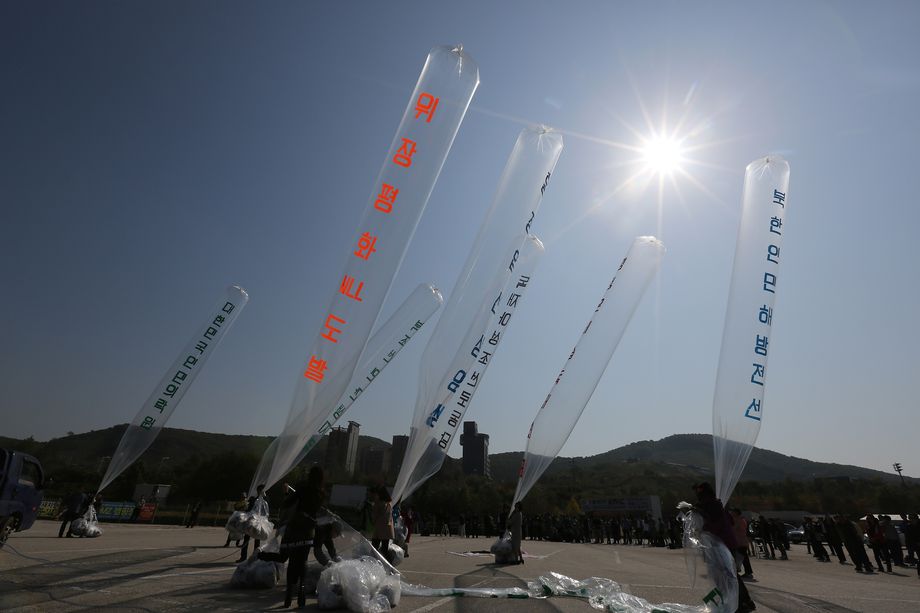
Lowest tech of all: There are messages and propaganda floated across the borders on balloons. These propaganda balloons eventually land in random neighborhoods with US currency, is drives packed with subversive western movies and music. The balloons often put messages on the back of these portraits of the dear leader, which makes them illegal to destroy. Even if caught with these balloon-bourne packages, a North Korean citizen can claim they were protecting the image of Kim Jong Un, which is part of their sworn duty.
Digital Underground
Fast-forward from the low-tech VHS era to the present and North Koreans are skyping with family members who have defected. Almost everyone is trading in illicit, compact, hand-held video players which only need solid-state thumb drives to play movies. Digital video players can even solar charge, so there’s almost no evidence that they exist.
A complicated web of western propaganda, South Korean, Japanese, and Chinese media reaches nearly everyone in North Korea these days. It is easier than ever for people to hide digital media files, and the regime is not savvy enough to truly stop the information flow.
New Generation Rising
This chapter is where Baek becomes more speculative, describing the duality that comes with leading double lives.
Today’s North Korean youth, like the rest of the global youth, are completely absorbed in media, even if their access is clandestine. They binge watch, they argue over which characters they admire and wish to resemble. Yet, also like the rest of the planet, North Korea youth have trends that include right-wing patriotism and nationalism despite being themselves repressed.
It’s difficult for North Korean youth to imagine regime change, revolution, fighting back. They struggle to even embrace true freedom or romance, though they might watch it on secret screens. Maybe the youth patriots are acting out sour grapes emotional responses – or maybe they have been fully brainwashed.
Multiple defectors interviewed expressed struggling to even conceptualize freedom or change. They were not raised with the vocabulary or the self-esteem to articulate how they truly felt. Despite seeing films and shows about people who are free to be themselves, they just did not think it was possible in real life – but they kept watching the illegal media.
 This article was made possible by R. Nicholas Starr, founder of Kunstwerk Multimedia. Musician, award-winning artist, and journalist, Starr explores an immersive science fiction world primarily through music. Releasing under the names of Esgal, Tobias Keller, Borgasm, and soon ArTek, each project becomings it’s own character in Starr’s Protean world.
Starr is also a biohacker, researcher, and active in the US Transhumanist Party, publishing several non-fiction works related to transhumanist topics. For more information, visit https://www.kunstwerkmultimedia.com
Implications, Predictions and a Call to Action
I find Baek’s interpretation of the stories in previous chapters completely agreeable. This final chapter outlines the political, military and social obstacles to true change in North Korea. Next, Baek expresses her belief that information is the most feared weapon in the eyes of Kim Jong Un.
There are western concerns about information dissemination into North Korea, that it is a form of imperialism or merely a counter propaganda stream that does nothing positive, an opinion Baek disagree a with. The west does not have a successful track record of establishing healthy, effective governments after defeating dictators.
Baek claims defectors are the most ardent proponents of sending more information into NK. Baek also cites East Germany and USSR as examples of historically comparable, successful information dissemination campaigns.
This last chapter acknowledges the difficulties in encouraging change in a fear-based culture but with encourages the reader to support change in North Korea against those odds. The book paints the picture of what that support looks like and how it is important to take the long view.
Baek speculates about possible reunification with the South and the problems and ramifications of reunification, including this list of unanswerable questions:
What will happen to North Korea’s nuclear weapons, including those in their undisclosed nuclear sites? What about the possibility of loose nuclear weapons being sold to other rogue states or nonstate actors such as extremist groups? How will North Korea’s 1.2 million-strong military special forces, and secret police be integrated with South Korea’s military? How can the expected mass southern-bound migration patterns of North Korea’s into South Korea be managed and controlled, assuming that the demilitarized zone will be made safe for crossing? What will happen to the thirty thousand American troops in South Korea? If the countries unify, will the troops remain on the Korean peninsula, further straining the United States security relationship with China? How will the infrastructure of the two countries, including their transportation, communication, health, education, and political systems, be integrated? What will happen to North Korea’s leadership and elite class? Will Kim Jong Un or his successor be a part of a unified Korean political leadership? And will he be sent to the International Criminal court based on the United Nations’ recommendation in 2014? Will some elites be granted amnesty or punished for their crimes against humanity?
As you can probably see, I dug way into this book. I learned things I didn’t even know I wanted to know, illuminated a dark spot in my willpower I didn’t realize was there. My understanding of the international stage is vastly improved.
I also loved the format, the ritual. I enjoyed forcing my tech-addled brain to use a reference book. As a reference book the sourcing, index, and searchability make me want to hang onto this copy. Plus, the plight of the information starved North Koreans makes me appreciate the book that much more.
It took me about six months to finish reading Hidden Revolution, but the bulk of that effort has been in the last two weeks.
I am so glad that I read this book cover to cover, perusing through the blurbs on the dust jacket and checking out the table of contents before I finally sinking my teeth into this author’s note. It is very easy to flip through nonfiction looking for the juicy bits and some people overlook practices and preambles altogether. Instead of just learning a little something more about North Korea, I found myself becoming a fan of Jieun Baek. Check out this little blurb I found under her photo on the back flap of the dust jacket:

Jeiun Baek is a PhD candidate in public policy at the University of Oxford. Previously, she was a research fellow at the Belfer Center for Science and International Affairs at Harvard University and worked at the Google, where, among other rules, she served as Google ideas North Korea expert. Beak received her bachelor’s and master’s degrees in public policy from Harvard. Visit her at www.JeiunBaek.com.
Even as I write this review of North Korea’s Hidden Revolution, I’m realizing how much more useful it to follow the career of the author. She’s written this book as a small part of a career spent becoming an expert on North Korea, or just as a political entity but as a people and as an emerging technology and propaganda case study. Throughout Hidden Revolution, Baek acknowledges the subject is in flux, constantly changing even as the book was being written.
Verdict:
I found this 2016 hardcopy to add a deeper, more interactive quality to any subsequent mention of North Korea and related international and cultural news that shows up in my feed. I am palpably more aware of the role of technology in resistance against oppression. Confidence in my own ability to parse current and future narratives regarding North Korea has improved, as well. Shout out to hardcover books uploading encyclopedic data to my brain, low-tech style.
Want a digital copy of North Korea’s Hidden Revolution: How the Information Underground Is Transforming a Closed Society? You can find one here.
Some of the links included in this article are Amazon affiliate links. If you would like to purchase these items, consider using the links provided and help support Neon Dystopia.