Drum Memory Blues: a review of proto-cyberpunk novel Simulacron-3 (1964)
2018 Books & FictionDaniel F. Galouye’s 1964 proto-cyberpunk novel Simulacron-3 takes place in a world where opinion polls are mandatory. As you stroll the sidewalk, someone might come to you with a notepad, flash a badge and proceed to ask your opinion on that particular toothpaste. If you decline, you get a fine. This is how corporations fix their products, this is how politics are decided. Douglas Hall, the novel’s main character, is a computer scientists whose work is to build, by way of a super-computer called Simulacron-3, an exact replica of the world in which the reactions of virtual persons to that damn toothpaste would be recorded and then we could put down those endless polls. Hall thinks his simulation would be a great way to anticipate problems and help make the real world a better place. His boss, though, thinks this would be the perfect tool to win an election and seize power.
Sounds familiar? Please, click “LIKE” if it does.
But this is the sixties, Philip K. Dick has just published The Man in the High Castle, and the full-fledged LSD epidemic is just around the corner. In phase with this Zeitgeist, the main focus of Simulacron-3 is the “counterfeit world” (as says the title of the British edition), and the anxious possibility that Hall’s very own reality could be a simulacra too.

Indeed, the modern reader who has now read Dick and watched The Matrix understands fast enough that something is fishy with the world in which Hall lives, while the poor guy only starts mid-book to question the reality of his environment. While the novelty of that concept is unfortunately somewhat spoiled by years of speculative fiction exploring the question of reality, the novel still is enjoyable from this perspective. Hall’s quest reads like a detective novel, as the starting point of the story is the “accidental death” of Dr. Fuller, Douglas Hall’s mentor and creator of the Simulacron-3. Of course, as this death seems increasingly not accidental as the novel goes, Hall understands that he could suffer the same fate, or worst, that the whole world could be wiped out. And time is running out. The problem Hall has is not so much how to uncover the truth as it is how to keep the sham together in order to not get erased.
The main difference between Galouye’s book and Dick’s stories is that in the latter the simulacra reality is usually the consequences of drugs (The Three Stigmatas Of Palmer Eldritch; Flow My Tears, The Policeman Said), alien intervention (The Cosmic Puppets; Ubik) or spirituality (The Man In The High Castle; VALIS). While Dick is without a doubt a prime cyberpunk forerunner, Simulacron-3 is all about computers, complete with “drum memory” and punch cards, and the possibilities of those machines, including the “hacking” of reality.

Therefore, in Galouye’s book humans are on both sides of the conflict, even though some are “simulated humans”. The world they live in might be virtual, but their consciousness is not. It is a man-made world inside a man-made world, and the ethical implications are murky. The Simulacron-3 could help manage the nation efficiently, but it would put the pollsters to unemployment, and they do constitute the most important corporation in this peculiar society. And as you might have guessed, the pollsters are in fact an “upper universe’s” version of Hall’s Simulacron-3, so what happens if the data collecting becomes redundant, or if one collecting device is cut short by the other and therefore becomes useless to the man who is really in control?
One of the reasons I personally don’t think much of the Matrix trilogy is that it quickly reverts to an “Us versus Them” rhetoric. Sure, the enemy is not an alien invasion force but rather an AI, but it’s an AI with evil-looking physical incarnations that you can shoot at. “The only good AI is a dead AI.” The metaphysical argument in the Matrix is the spiritual question of the soul : “real” humans must resist to the soullessness of the machines.
Simulacron-3, on the other hand, raises the ontological question of consciousness. As Hall realizes that the virtual human beings inside the Simulacron-3 acquire some form of consciousness, he starts to ponder the implications of simply “erasing” defective units, such as those who begin to understand that they are indeed virtual people. And as he realizes that he himself could very well be a simulacra, he starts to wonder whether or not he is being perceived as a “defective unit” by whoever is in control.
And as I was reading Simulacron-3, the Cambridge Analytica scandal broke out. We all knew that algorithms were forcing our experience of the net one way or the other, but to some extent we had accepted that it was sort of a blind process whose only intention was to sell us, well, toothpaste. But just as in Simulacron-3, there is still a human behind the terminal, calling the shots.
In 1950, the father of cybernetics, MIT mathematician Norbert Wiener published a book to explain his work to the general public. Despite its ominous title, The Human Use of Human Beings is a book about ethics and responsibilities. The study of information, feedback and learning machines would lead us into new means of knowledge and control, and as with any new technology we have to be careful to use this in a humane way. There is a passage in the book (p. 178-181) where Wiener talks about a “governing machine”, one that would record opinions and predict outcomes of any socio-political situation. And though such a machine seemed improbable to Wiener, he nevertheless warns us :
“The machine à gouverner of Père Dubarle is not frightening because of any danger that it may achieve autonomous control over humanity. It is far too crude and imperfect to exhibit a one-thousandth part of the purposive independent behavior of the human being. Its real danger, however, is the quite different one that such machines, though helpless by themselves, may be used by a human being or a block of human beings to increase their control over the rest of the human race or that political leaders may attempt to control their populations by means not of machines themselves but through political techniques as narrow and indifferent to human possibility as if they had, in fact, been conceived mechanically. The great weakness of the machine – the weakness that saves us so far from being dominated by it – is that it cannot yet take into account the vast range of probability thatthe human situation. The dominance of the machine presupposes a society in the last stages of increasing entropy, where probability is negligible and where the statistical differences among individuals are nil. Fortunately we have not yet reached such a state.” (Norbert Wiener, The Human Use of Human Beings, London, Free Association Books, 1950, p. 180-181)
Wiener’s 1950 had not reached such a state yet, but then here we are. Galouye may or may not have known about Wiener’s researches, nevertheless while writing a fiction about reality and virtuality he wrote a book about the consequences of a cybernetic behavioral machine, and about the more general consideration of corporate capitalism and politics entanglement.
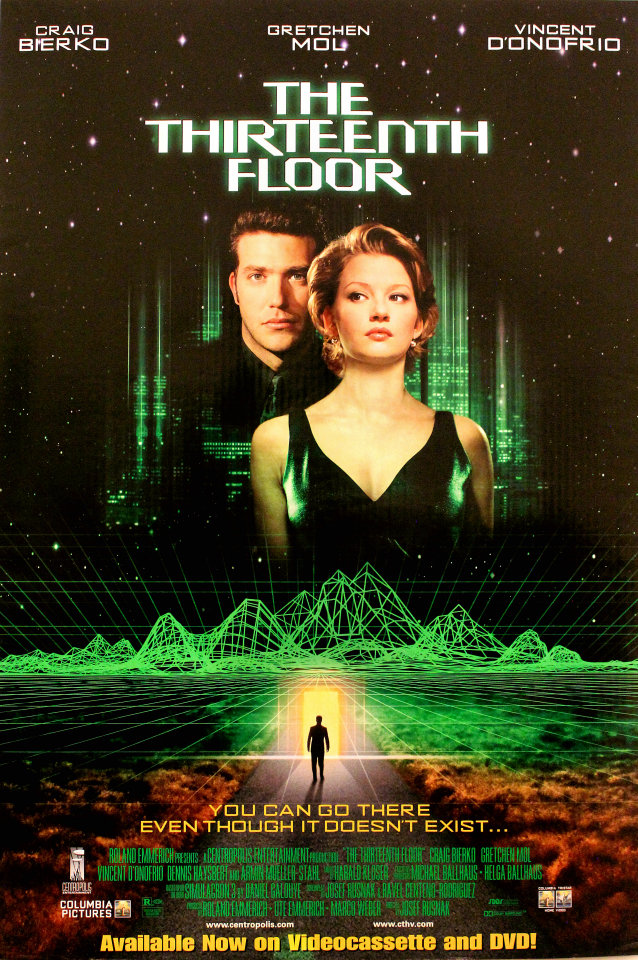
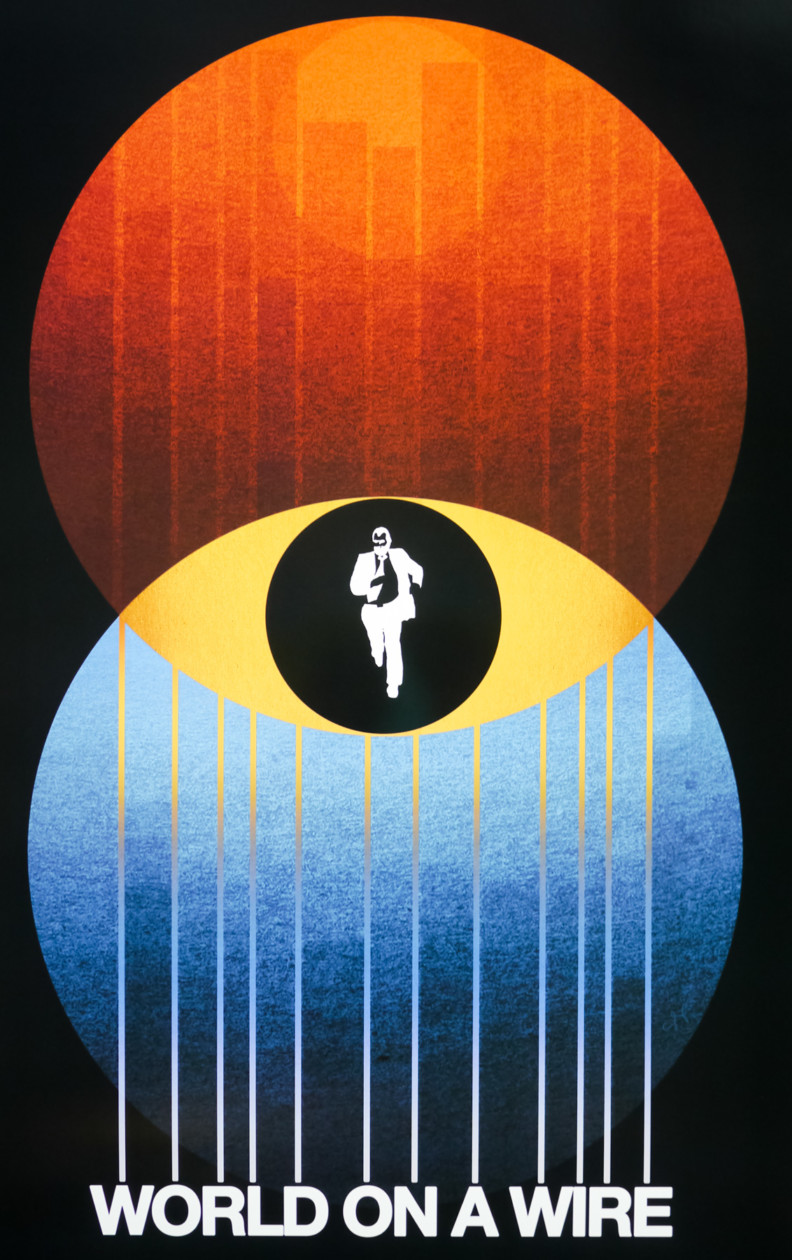
An AI using big data to control mankind is obviously a bad idea. But we should never forget that AIs are “learning machines”, and that, as “Ex Machina” exposes with flying colors, we are their mentors. Simulacron-3 has been adapted for the screen twice: Welt am Draht (1973), by Germany’s bad boy Rainer Werner Fassbinder, allegedly faithful to the novel, and The Thirteenth Floor (1999), very loosely inspired by the novel.
Simulacron-3 – 8/10
If you’d like to explore the pre-matrix, proto-cyberpunk novel Simulacron-3, you can get a copy here.
Some of the links included in this article are Amazon affiliate links. If you would like to purchase these items, consider using the links provided and help support Neon Dystopia.
Big fan of World on a Wire, but never read this source material. It’s odd but I’ve always felt a nostalgia for the 1970s Germany presented in the film even though I’m not German and wasn’t born yet.