The Early Life of the Word "Cyberpunk"
2016 Books & FictionWhen Neuromancer came out in 1984 the word “cyberpunk” had not yet come to be associated with a new literary movement. The gears of the cyberpunk movement began to turn with early cyberpunk novels like Transmanicon (1979) and City Come A-Walkin’ (1980) from John Shirley, The Artificial Kid (1980) by Bruce Sterling, and a slew of short fiction from the likes of Gibson, Shirley, Sterling, Pat Cadigan, and many more. And it wasn’t just a literary movement; movies like Escape from New York (1981), Alien (1979), and Blade Runner (1982) began to solidify the visual aesthetic. Neuromancer, though, was the moment everyone noticed that this was a pattern. The tropes had all come together. In 1986, well after cyberpunk was the accepted word to describe this new science fiction movement, Norman Spinrad suggested that the real word we should be using to describe cyberpunk was “Neuromantics” because people were mostly copying Neuromancer. This is a short sighted diagnosis, but there is a modicum of validity; so why did we choose cyberpunk?

In spring of 1980, Bruce Bethke was trying to coin a term to describe the next generation of “motorcycle punks.” There wasn’t a good word to describe this coming archetype and so he “set out to create and define that word.” The core idea that inspired the term was:
The kids who trashed my computer; their kids were going to be Holy Terrors, combining the ethical vacuity of teenagers with a technical fluency we adults could only guess at. Further, the parents and other adult authority figures of the early 21st Century were going to be terribly ill-equipped to deal with the first generation of teenagers who grew up truly “speaking computer.”
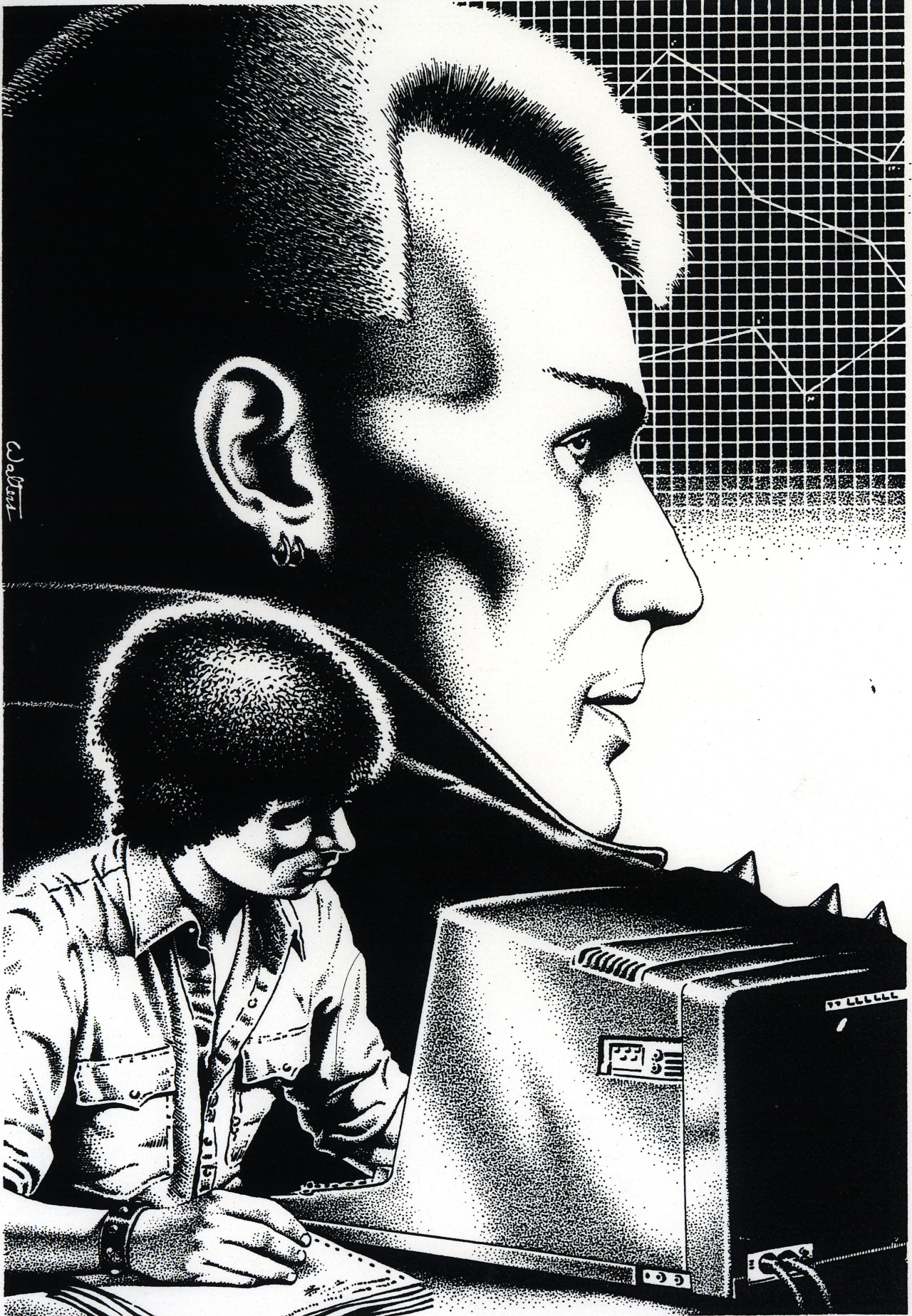
The word then became the very intentional title for his short story, Cyberpunk, about a group of hacker teens bucking the system, exploiting systems for personal gain, and rebelling against their parents. This is a common trope now, but when Bethke wrote about it, it was a new idea. It wasn’t until July 1982, though, that Bethke finally sold the story to the magazine Amazing Stories and it was November 1983 before the story was published. The story also popularized the vision of the teenage hacker with a mohawk, which was inspired by the visage of Billy Idol; who ironically would go on to adopt the cyberpunk identity with his 1993 Cyberpunk album.
The word was popularized by Gardner Dozois in his 1984 article for the Washington Post, called Science Fiction in the Eighties, to describe the new wave of science fiction writers.
About the closest thing here to a self-willed esthetic “school” would be the purveyors of bizarre hard-edged, high-tech stuff, who have on occasion been refereed to as “cyberpunks” — Sterling, Gibson, Shiner, Cadigan, Bear.
The name was thereafter sealed in the ink of the science fiction authors of the ’80s. Bruce Sterling then owned the term in the essential 1986 anthology: Mirrorshades – The Cyberpunk Anthology. Although at this point the cyberpunk aesthetic had been well established, Mirrorshades was the first collection of cyberpunk works and was edited by one of the original cyberpunks, giving it additional credibility. If Dozois sealed “cyberpunk” in ink, Sterling etched it in stone. Since the invention of the word in 1980, it has “gone on to have quite an interesting career of its own,” as Bethke has said.
The term Cyberpunk is in the public domain, and that matters.
The term cyberpunk is in the public domain, and NO ONE has the right to trademark Cyberpunk™ the comic book, or Cyberpunk™ the card game, or Cyberpunk™ the crappy derivative franchised YA novel series. — Bruce Bethke
This allows the term cyberpunk to maintain its “punkness.” Billy Idol pushed it with his album Cyberpunk, the roleplaying game Cyberpunk 2013/2020 added the year so R. Talisorian Inc. could trademark the name, but we all get to use the term. This has allowed for a culture to rise around the word. Literature, movies, television, comics, music, these are all things that define a culture. Because Bethke didn’t trademark the word, it is our word. An open source term that can continue to evolve as the culture evolves. Cyberpunk will never die, because it can change. As long as humanity isn’t perfect, as long as there are haves and have-nots, and as long technology is integral part of who we are, cyberpunk will persist. The cyberpunks are here, and we aren’t going anywhere.
In 1989, Bethke sold a completed novel based on the original short story, but it was never published due to conflict over the ending. Bethke has made the novel available for free on his website. Or you can read the original short story here.
You can read Bethke’s full essay on “The Etymology of “Cyberpunk,” on his website.
You can find Bethke’s published cyberpunk novel, Headcrash, here.
Some of the links included in this article are Amazon Affiliate links. If you would like to purchase these items, consider using the links provided and help support Neon Dystopia.
Interesting, I didn’t know some of the history of Cyberpunk. I think you did miss one very early but very important mile stone book… John Brenner’s Shockwave Rider (1975). https://en.m.wikipedia.org/wiki/The_Shockwave_Rider
Shockwave Rider is referenced by Bethke as part of the inspiration for his short story, Cyberpunk. I considered including this part, but decided it was more relevant to a discussion about proto-cyberpunk than the origin of the word. Thanks for pointing it out though!
Sigh… “Brunner”… do you think the Cyberdeck 7 had annoying autocorrect? 🙂
I do find it interesting that Brunner’s The Shockwave Rider, published in 1975, is considered by genre historians to be proto-cyberpunk while Gibson’s Fragments of a Hologram Rose, published in 1977, is considered to be the first cyberpunk story. It’s not exactly clear what the missing components were that keeps The Shockwave Rider and similar works being deemed proto- instead of canon cyberpunk, but the time to transition from proto- to the fully realized sub-genre is a lot narrower than many would think. However, the ideas had been around for decades, perhaps as long ago as 1953 with Bester’s The Demolished Man.
I agree, the roots to cyberpunk reach back pretty far. I think that Gibson is seen by many as the creator of cyberpunk and therefore anything written by him is cyberpunk by default. There really isn’t a specific instance when things become cyberpunk, so it could be argued that the Shockwave Rider is, in fact, cyberpunk. I see the emergence of cyberpunk as more of a gradient of events rather than a moment in time. As we approach Neuromancer, we see more and more cyberpunk like work, then the 80s and early 90s are full of it, then as interest wanes and post-cyberpunk becomes less focused on the punk elements we see a dip. I think the current part of the gradient is moving back towards purer cyberpunk.
Definitely, Neuromancer is the book that had every editor, agent, and publisher in the business saying, “Damn, I got to get in on that action!” That’s one of the things that makes it really hard to discuss literary history. Writing is a craft, that sometimes rises to being an art, but publishing is a *business*. So there’s what writers are actually thinking about and doing, and then there’s what magazine editors are buying and publishing, and then there’s what book publishers are buying and publishing, and then there’s what editors and agents are looking for, and there’s always about a two-year time smear between each step in this chain. (Editors and agents are *always* looking for a book exactly like last year’s big bestseller, “only different.”)
So what happened by the late 1980s/early 1990s is that every agent, editor, and publisher in the business was saying, “Cyberpunk is hot. We need to get us some.” And by that point there were a lot of people who’d learned how to *fake* the cyberpunk style well enough to sell it editors and publishers, who, let’s be honest, as a class, are people who have trouble knowing which end of a hot soldering iron to hold, and the result was what the result always is. In short order, the market got saturated with Imitation Neuromancer novels that copped the look and feel but didn’t have anything *new* to say, and the readers got bored and moved on to something else.
Why is The Shockwave Rider considered proto-cyberpunk and not true cyberpunk? Beats me. You may as well ask why Twain’s _A Connecticut Yankee in King Arthur’s Court_ is considered a burlesque of a Romantic chivalry novel and not science fiction.
Thanks for kind words, Isaac!
(Oh dear God. I really used to look like that? For whatever it’s worth, I lost the beard and mustache about 15 years ago.)
It was seriously my pleasure. I love your short story and have been meaning to paw my way through the full length novel.
Actually, I think you’d enjoy _Headcrash_ more. My cyberpunk novel has some…issues.
You got me thinking: aside from listening to way too much Clash and Buzzcocks, what else was influencing me at the time I wrote this thing? Definitely Tony Burgess’s 1962 novel, A Clockwork Orange. Definitely John Brunner’s 1975 novel, The Shockwave Rider. (Weird historical factoid: John Brunner was a friend, and I was drinking with him the night he died. This thought still creeps me out a little.) To a lesser extent John Sladek’s novels, The Muller-Fokker Effect and Mechasm. (Sladek was also a very good friend, and I still miss him.) Yes, Bester’s The Demolished Man, though if you want to get picky that could be dated back to 1951, as that’s when it was serialized in Galaxy. I was also going through a Philip K. Dick phase at the time, though I can’t point to any obvious bits that I lifted from PKD. But the two books that really contributed most strongly to my sense of what the techno future would be like were The Godwhale, by T.J. Bass (good luck finding a copy of it now), and A Specter is Haunting Texas, by Fritz Leiber, which I first read when it was serialized in Galaxy in 1968.
Of course, the one I read later, that had me saying, “Damn, I wish I’d written that!” was “True Names,” by Vernor Vinge.
Thank you for sharing the anecdotes, and that is one hell of a weird historical factoid. Also, True Names is an excellent novella that I really should also write about.
Of course, those are just the traceable, citable influences. A lot of the deep concept probably evolved from all those late-night bull sessions with two of my oldest and best friends (and former roommates), Dr. John [name redacted], whose A.I. software is still crawling around inside rovers on Mars, and Dr. Charles [name redacted]. recently retired after a long and successful career spent designing “smart” weapons and blowing shit up.